
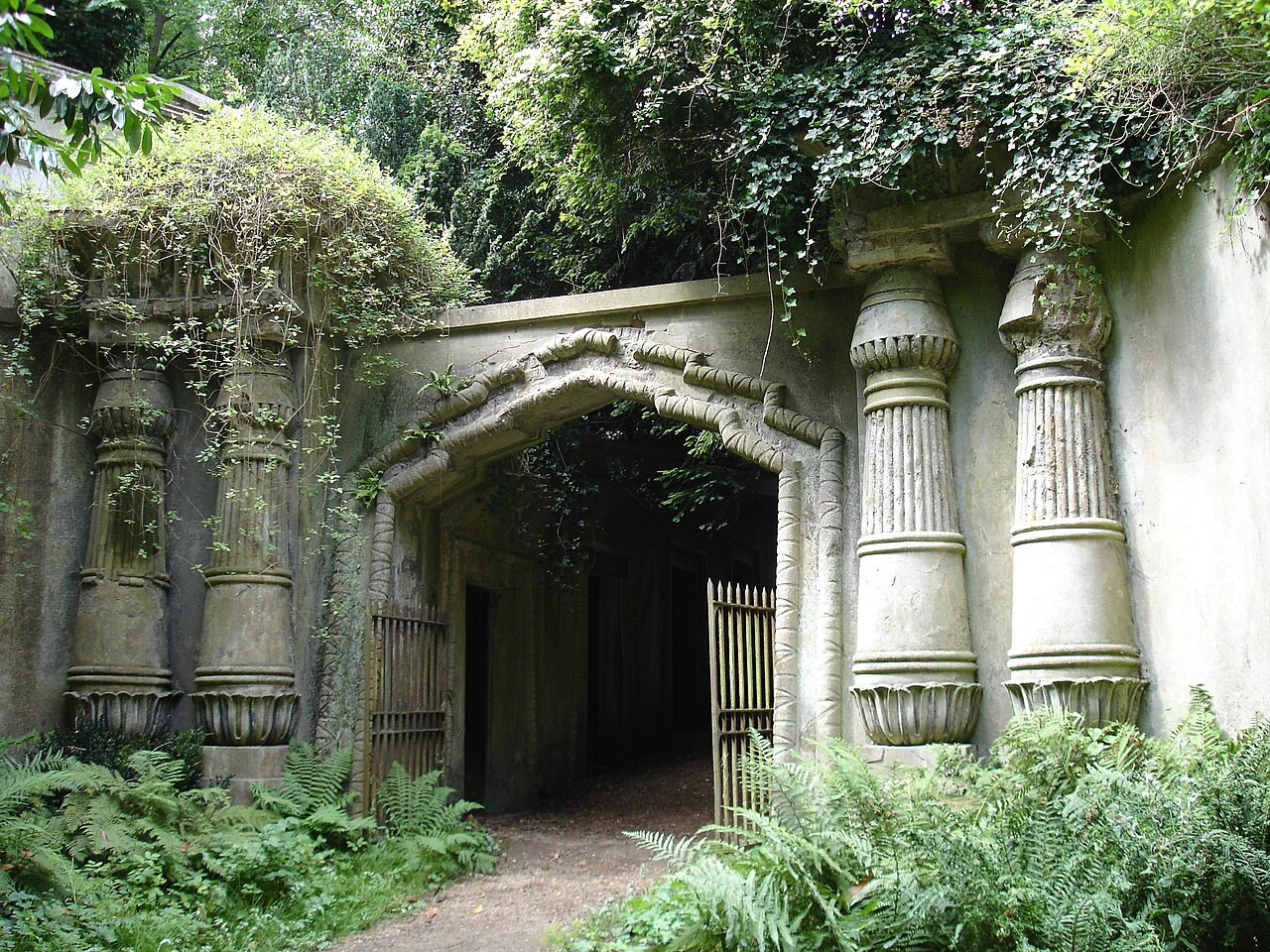
Highgate Cemetery in North London opened in 1839 and is best known today for its Victorian Gothic architecture, its overgrown hillside paths and the graves of some well-known people. It also carries a more recent tale, the “Highgate Vampire,” a media sensation of the early 1970s. The architecture and the history are well documented. The vampire is a story that grew in the press, and the same events involved real damage to graves.
A Victorian cemetery on a hillside
Highgate was opened by the London Cemetery Company as one of seven large cemeteries ringed around the edge of London, now called the “Magnificent Seven.” Inner-city churchyards could no longer cope with the number of burials. Wikipedia says the western section was dedicated on May 20, 1839, with the first burial days later. The architect and entrepreneur Stephen Geary designed the original layout. The cemetery soon became a fashionable place to be buried and to visit, and it filled with elaborate Gothic tombs.
A second, eastern section followed. Wikipedia says land across Swain’s Lane was bought in 1854 and the extension opened in 1860, and the BBC dates the extension to 1854. Both sides are still used for burials. The BBC records more than 168,000 names in over 52,000 graves, while Wikipedia gives about 170,000 people in around 53,000 graves, on about 37 acres.
Egyptian Avenue and the Circle of Lebanon
The BBC says the Egyptian Avenue, a passage of family vaults entered between an obelisk and lotus-flower columns, reflects the Victorian fascination with ancient Egypt. It leads to the Circle of Lebanon, a ring of vaults around a cedar of Lebanon. Wikipedia says both are Grade I listed, and that the original cedar was cut down and replaced in 2019. At the top of the hill, the Terrace Catacombs and the Julius Beer Mausoleum are both Grade II* listed. In the eastern section, a bust marks the grave of Karl Marx.
From neglect to charity
The London Cemetery Company went bankrupt in 1960, and the grounds became thickly overgrown. Wikipedia says a charitable trust, the Friends of Highgate Cemetery Trust, was set up in 1975 and had acquired the freehold of both sides by 1981. Today the cemetery is a working burial ground and a de facto nature reserve.
The Highgate Vampire story
Wikipedia’s account of the “Highgate Vampire” is the main basis for this section. Its article notes that the most thorough study is a 1993 article in the journal Folklore, which was not read for this post.
On October 31, 1968, a group visited Tottenham Park Cemetery, where a coffin was opened and a stake was driven through its lid, according to a London newspaper report of the time. The people responsible were never identified. Some at the time linked the incident to the Highgate story, but that link is conjecture.
In February 1970 a letter to the Hampstead and Highgate Express described a “grey figure” seen near the cemetery on December 24, 1969, and asked whether anyone else had seen something similar. Replies described a tall man in a hat, a spectral cyclist, a woman in white, a face glaring through the bars of a gate, a pale gliding form, bells ringing and voices calling. One of two rival occultists then claimed the figure was a vampire, and the press embellished the idea.
On Friday, March 13, 1970, after a television broadcast about the story, a crowd of self-styled hunters swarmed over the gates and walls into the locked cemetery. On August 1, 1970, a woman’s charred and headless remains were found not far from a catacomb, and the police suspected black magic. In July 1974 one of the two men was jailed for four years and eight months for damaging memorials and interfering with the remains of the dead, which he denied was his doing. The two men feuded in print for decades. Both are left unnamed here, and each has told the story differently.
Wikipedia lists the episode among London folklore and “paranormal hoaxes.” No vampire has been shown to exist. What can be documented is the letters, the crowd, the desecration and the prison sentence.
Reported ghosts
The 1970 letter-writers’ sightings are the only reports of a ghost at Highgate that the sources describe. They are uncorroborated, and no witnesses are identified in the material read. Treat them as folklore.
Visiting Highgate Cemetery
On October 26, 2026 the cemetery’s official visitor page listed daily hours of 10 a.m. to 5 p.m. from March to October, with last entry at 4:30 p.m., and 10 a.m. to 4 p.m. from November to February, with last entry at 3:30 p.m. It listed closures on Christmas Day and Boxing Day and said access can be restricted during funerals and bad weather. Hours and prices change, so recheck the official site before going.
- One ticket, both sides: the page says a ticket covers both the West and East sides, and that guided tours are recommended for first-time visitors. Tours last about 75 minutes.
- Prices: the page does not give a price in the text read. Check the ticket page.
- Respect the dead: the cemetery is a working burial ground. Staying on the paths is required, and climbing on monuments is prohibited.
- Photography: personal photos are allowed with a handheld camera. The cemetery says permits are needed for subjects with a supernatural element and that permission is most unlikely to be granted.
Frequently asked questions
Is the Highgate Vampire real?
No evidence supports a vampire. The documented events are a 1970 letter, a crowd of hunters, damage to graves and a later prison sentence.
When did Highgate Cemetery open?
The western section was dedicated on May 20, 1839. The eastern section followed, and sources give 1854 or 1860 depending on whether they count the land purchase or the opening.
Is Highgate Cemetery open to the public?
Yes, as a visitor attraction with a ticket, but it is also an active burial ground. See the visiting section above, and recheck the official page.
Who is buried at Highgate?
Many notable people. The BBC counts at least 850 notable burials, including Karl Marx.
More haunted cemeteries: Another large Victorian garden cemetery is Graceland Cemetery in Chicago. For ghost lore among old tombs, see Oak Hill Cemetery in Washington, D.C..
Sources
- Wikipedia: Highgate Cemetery: history, listings and the 2019 cedar replacement.
- Wikipedia: Highgate Vampire: the 1968 to 1974 events.
- BBC London: Highgate Cemetery (archived 2014): burial counts and the Egyptian Avenue.
- Highgate Cemetery: Visitor information: hours and rules, read October 26, 2026.
Shop the gear
NicheStuff is our own shop; some links in this post go to products we sell.
Top image: Egyptian Avenue Highgate Cemetery, JohnArmagh, public domain, via Wikimedia Commons.