
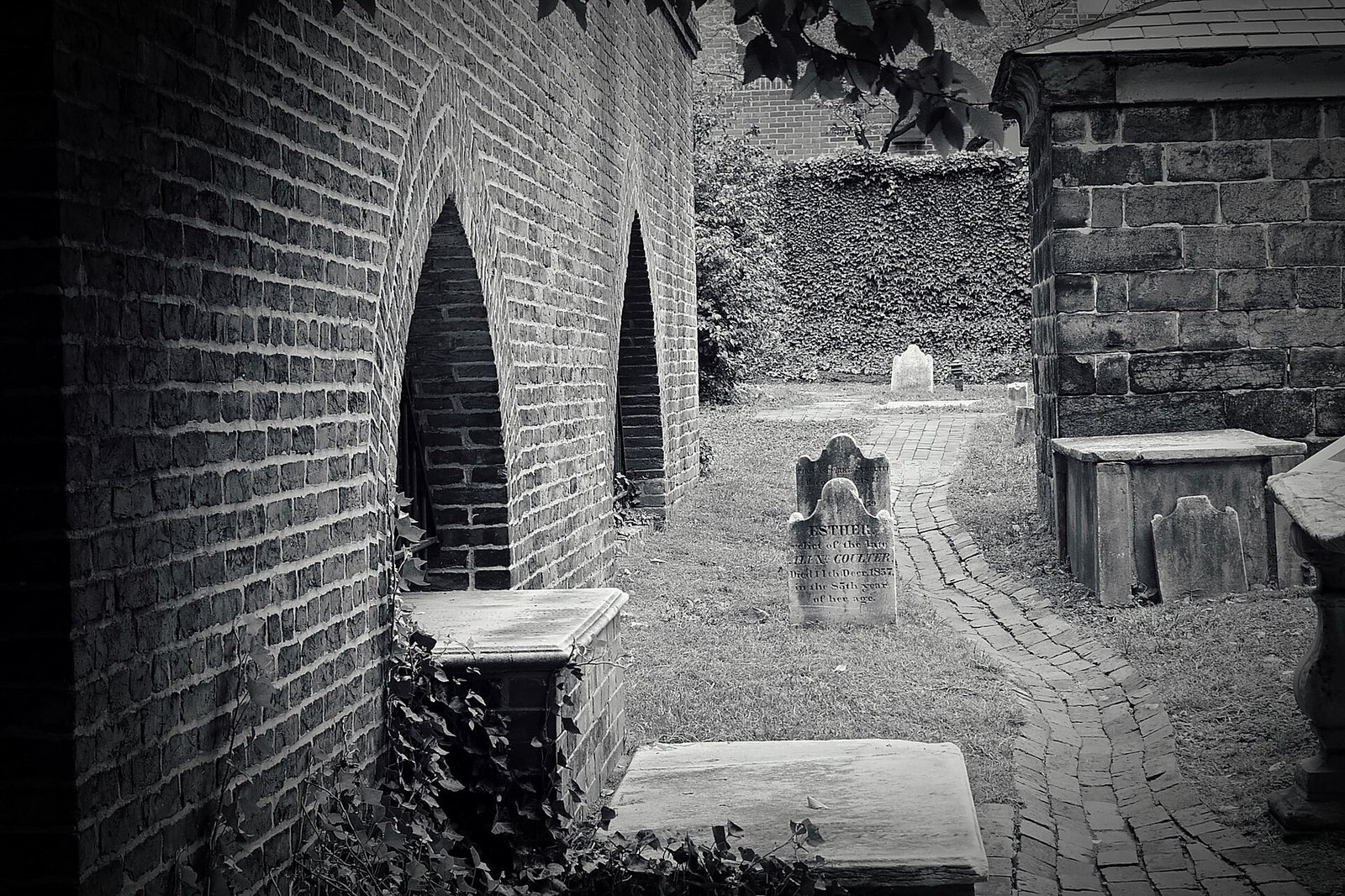
Westminster Hall and Burying Ground is a former church and 18th-century graveyard in downtown Baltimore, Maryland, best known as the burial place of Edgar Allan Poe. Its brick church stands on piers over some of the graves, creating the “catacombs,” and the combination of a famous literary grave, a below-ground burial space and a long-running midnight tradition has given the place a ghost-story reputation. This post separates the documented history from the lore, and uses the site’s own pages for visiting details, because the burying ground is open to the public and its operators publish the rules.
What the record shows
Westminster’s own history page says the burial ground, originally the Westminster Presbyterian cemetery, was established in 1786. Baltimore Heritage also says 1786, while Wikipedia says January 1787, so the year is stated differently in different sources. In 1852 the church was built on brick piers above the graves, creating what the site calls “remarkable catacombs.” The church was in use until 1977, and a preservation trust formed that year restored the building, now called Westminster Hall, in 1983. It is used for weddings, lectures and events. Westminster was placed on the National Register of Historic Places in 1974.
The burying ground holds nearly 300 veterans of the Revolutionary War and the War of 1812, according to the site, including General Samuel Smith and James McHenry, the namesake of Fort McHenry. The site also notes Maximilian Godefroy’s Egyptian Revival gates on the Greene Street side.
Edgar Allan Poe died in Baltimore on October 7, 1849. Westminster says he was first buried in an unmarked grave toward the back of the cemetery, and that in 1875 a monument funded by “Pennies for Poe,” a fundraising project of Baltimore schoolchildren, was dedicated at the front of the cemetery. The site says he is buried with his wife, Virginia Clemm Poe, and his mother-in-law, Maria Poe Clemm. Wikipedia adds that his first burial spot, near the back of the hall, is still marked by a headstone with an engraved raven.
The legends
The ghost lore here centers on Poe more than on any single apparition. Wikipedia notes that an episode of the Canadian television series Creepy Canada, filmed here, discussed rumors that Poe’s ghost haunts the burying ground and that paranormal investigators have discussed a possible haunting. None of the sources read names a specific ghost or describes a documented sighting.
The best-known tradition is the Poe Toaster. For decades an unidentified figure in black, with a white scarf and a wide-brimmed hat, entered the burial ground in the early hours of January 19, Poe’s birthday, poured a glass of cognac at Poe’s original grave, raised a toast, left three roses and the unfinished bottle, and vanished. Wikipedia says eyewitnesses placed its start in the 1930s, though no report appeared in print until 1950, and that the visits seemingly ended after 2009. A new, publicly organized version began in 2016. A claim that the whole tradition was a 1960s publicity stunt was made in 2007 and was never definitively disproved, but published reports of the visits are older than the 1960s. The Toaster is a ritual, not a haunting, but it is a large part of the grounds’ folklore.
Baltimore lore also says the 1875 reburial put the wrong remains in the new grave. Baltimore Heritage calls the wrong-remains story probably not true, but confirms a different claim: the monument’s inscription gives the wrong birth date (it reads January 20, while January 19 is the date used for Poe’s birthday).
What the record does not support
- The “ordinance” story. For years it was said the church was built over the graves because of a city ordinance against cemeteries not next to a church. Wikipedia reports that research in the early 1980s found no such ordinance. The congregation wanted to serve the growing west side of the city and to protect an old-fashioned burying ground.
- Hauntings. The paranormal claims rest on rumor and on investigators’ discussion, not on a documented incident.
- The Toaster’s age. Eyewitness accounts date the tradition to the 1930s, but the earliest published report Wikipedia cites is from 1950.
Visiting
Westminster’s tours page says the burying ground is open daily from 9 a.m. to 5 p.m. and closes if there is ice or snow. The entrance is at the corner of Greene and Fayette Streets, and the street address is 519 W. Fayette Street according to Baltimore Heritage (Wikipedia lists both 519 and 509). If the main gates are locked during open hours, the page says to call 410-706-6882 for University of Maryland, Baltimore campus security.
- Self-guided visits are free. Tour guides are not available on those visits.
- The catacombs are not open for self-guided tours.
- Public guided tours that include the catacombs are listed for the first Saturday of each month at 11 a.m. and 1 p.m., at $5 for adults and free for children 4 and under, with exact change requested. Private tours need a deposit two weeks ahead. Call 410-706-2072 or email info@westminsterhall.org. Baltimore Heritage offers separate catacomb tours with reservations through its own site.
- Stone or grave rubbing is not permitted.
- There are no restrooms on site. Parking is limited to the street or the Baltimore Grand Garage at 5 North Paca Street.
- Filming or events need advance contact with the Hall.
Hours, prices and tours can change, so confirm them on the Westminster Hall site before traveling.
A few points of courtesy apply: visit during open hours only, stay on paths, do not touch or lean on stones, and do not leave bottles or other items at Poe’s graves.
FAQ
Is Westminster Burying Ground haunted?
No haunting is documented. Rumors of Poe’s ghost circulate, and paranormal groups have discussed the site, but the sources read do not name a specific ghost or a recorded sighting.
Where is Edgar Allan Poe buried at Westminster?
His monument, dedicated in 1875, is at the front of the cemetery near the Greene and Fayette Street entrance. His first burial spot toward the back is marked by a stone with a raven.
What was the Poe Toaster?
An unidentified visitor who toasted Poe’s original grave with cognac and left three roses on his birthday, January 19, for decades. The tradition seemingly ended after 2009 and was revived in a modified, public form in 2016.
Can visitors enter the catacombs?
Only on a guided tour. Westminster says the catacombs are not open for self-guided visits.
More haunted cemeteries: Another Mid-Atlantic entry is Oak Hill Cemetery in Georgetown, Washington, DC. Northeast entries include Union Cemetery in Easton, Connecticut and Our Lady of the Rosary Chapel and Stepney Cemetery in Monroe, Connecticut.
Sources
- Westminster Hall: About: history, burials, the Poe monument, the 1852 church and the 1974 and 1977 dates.
- Westminster Hall: Tours: hours, gates, rules, tour times, fees and contacts.
- Explore Baltimore Heritage: Westminster Burying Ground: 1786 date, address, and the reburial and birth-date notes.
- Wikipedia: Westminster Hall and Burying Ground: the “ordinance” correction, the 1787 date, and the paranormal television mention.
- Wikipedia: Poe Toaster: the tradition, the 1950 report, the 2007 claim and the 2016 revival.
Shop the gear
NicheStuff is our own shop; some links in this post go to products we sell.
Top image: Gravestones and brick arches under Westminster Hall, Baltimore, November 2017. Photo: Mike2478, CC BY-SA 4.0, resized, via Wikimedia Commons.