
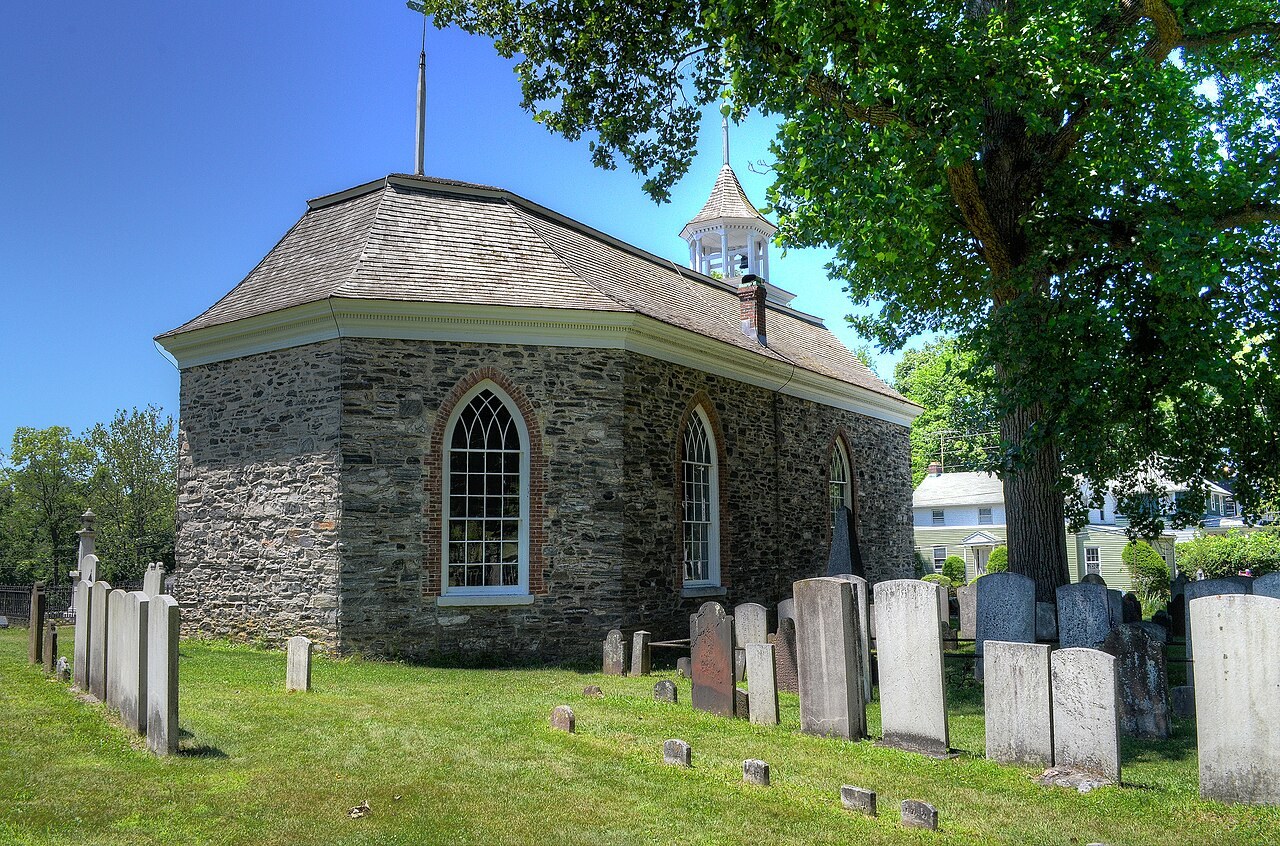
Sleepy Hollow, New York, is best known for one story: the Headless Horseman of Washington Irving’s 1820 tale. Two real burial grounds sit side by side here, and visitors often confuse them. One is the colonial Old Dutch Burying Ground beside the 17th-century Old Dutch Church. The other is the much larger Sleepy Hollow Cemetery, founded in 1849, where Irving himself is buried. The places are real and documented. The ghost is fiction.
Two burial grounds, one famous name
Wikipedia describes the three-acre Old Dutch Burying Ground as contiguous with, but separate from, the 90-acre Sleepy Hollow Cemetery. The cemetery was incorporated on October 29, 1849 as Tarrytown Cemetery and was renamed Sleepy Hollow Cemetery on April 11, 1865. Wikipedia says it followed New York’s 1847 Rural Cemetery Act, because the old churchyard no longer had room, and was laid out as a garden-style cemetery. It joined the National Register of Historic Places in 2009.
The Old Dutch Church and Burying Ground
The Old Dutch Church was built by Frederick Philipse, first lord of Philipsburg Manor, for his tenants. Its date is disputed. The church’s own website says it was built in 1685, the year engraved on its bell, and formally organized as a Dutch Reformed congregation in 1697. The National Park Service’s landmark nomination says it was constructed between 1697 and 1702 and that the exact date is uncertain. A marble tablet gives 1699. It is a National Historic Landmark.
Wikipedia says that enslaved laborers erected the stone church under Philipse. The same article says the records of the burying ground, which document over 1,700 names, do not name or locate the enslaved people of Philipsburg Manor, and that no trace survives of the burial place west of the church that some historical sources describe. The same article says enslaved people were not permitted headstones, and that simple wooden or fieldstone markers would long since have decayed.
The burying ground probably predates the church. Wikipedia gives its earliest legible stone as 1755 and says settlers may have been buried here before 1650. It holds founding families such as the Van Tassels and Martlings and one of the highest concentrations of Revolutionary War veteran graves in New York State.
Irving, the cemetery and the Hollow
Wikipedia says Irving was a cofounder of the cemetery. He is buried in the family plot beside his mother, about 150 feet from the churchyard graves of people said to have inspired his characters. Wikipedia says the stone visitors see today is the third marker, because souvenir hunters chipped away at earlier ones, and that it is the most visited place in the cemetery. The grounds also hold Gilded Age mausoleums and a Civil War soldiers monument.
A rustic bridge over a ravine of the Pocantico River is popularly linked to the bridge in Irving’s tale. The cemetery’s superintendent, quoted by Wikipedia, says visitors have long made that link, though the bridge is a much later addition.
Where the Headless Horseman came from
Irving published “The Legend of Sleepy Hollow” in 1820 in The Sketch Book of Geoffrey Crayon, Gent. In the story, the schoolmaster Ichabod Crane is chased one night by a headless rider, said to be the ghost of a Hessian cavalryman who lost his head in the Revolutionary War, and he races for the bridge by the old church. He is gone by morning.
Headless riders appear in older European folklore, which Irving may have known. A local explanation holds that a headless corpse was rumored to have been found here after the Battle of White Plains and was buried in an unmarked grave in the churchyard. The Old Dutch Church article notes a record of an anonymous Hessian soldier decapitated by a cannonball in that battle, but no documented record of his body being found and buried. Wikipedia also says Ichabod Crane may have been modeled on Jesse Merwin, a schoolteacher in Kinderhook, or on Samuel Youngs, a local schoolteacher, as many in the Tarrytown area claim. These are theories about the story’s roots, not proof.
Ghost lore and local legend
The sources reviewed document no sightings of the Horseman. The best-known local legend instead concerns the Bronze Lady, a mournful seated statue from 1903 by the sculptor Andrew O’Connor, commissioned by a general’s widow. Wikipedia says many praise its lifelike look while others, including the widow, found its expression unsettling, and that she asked the sculptor to replace its head and he refused. It calls the statue “a centerpiece of local legendry.” Treat any report of hoofbeats, a rider or a presence as folklore, since none was found with a named witness or a date.
What the record supports
The church, the burying ground, the cemetery and Irving’s grave are documented by federal listings and by the institutions themselves. The story is an 1820 work of fiction, and the Hessian and Ichabod Crane explanations are theories. The ghost stories told today sit on top of a real place where people are buried and mourned.
Visiting Sleepy Hollow Cemetery and the Old Dutch Burying Ground
On October 26, 2026 the cemetery’s official visiting page listed daily hours of 8 a.m. to 4:30 p.m. Monday through Friday and 8:30 a.m. to 4:30 p.m. on Saturday and Sunday, with individuals and families free to walk or drive the grounds. The church’s page said the burying ground is open daily until 4:30 p.m. Hours change, so recheck both official sites before going.
- Behave as at a funeral: the cemetery bans picnicking, sunbathing, smoking, alcohol and bicycles, and asks visitors not to touch monuments.
- Groups: only cemetery staff may lead tours, and unauthorized groups are asked to leave. The church asks tour groups for permission in advance.
- Photography: handheld photos for personal use are allowed. Tripods, drones and costumed photo shoots are not.
Frequently asked questions
Is the Headless Horseman real?
No. He is a character from Irving’s 1820 story. The sources describe real graves and a real church but no documented sighting.
Is Sleepy Hollow Cemetery the same as the Old Dutch Burying Ground?
No. No. They adjoin but are separate. The burying ground belongs to the Old Dutch Church, and the cemetery is a non-profit burying ground.
Where is Washington Irving buried?
In Sleepy Hollow Cemetery, in the Irving family plot, close to the old churchyard.
Can you visit both on one trip?
Yes, but each has its own hours and rules, listed in the visiting section above.
More haunted cemeteries: For another Northeast burial ground with a legend, see Union Cemetery in Easton, Connecticut. For an older Southern one, see Bonaventure Cemetery in Savannah.
Sources
- Wikipedia: Old Dutch Church of Sleepy Hollow: church history, the burying ground and the enslaved laborers.
- Wikipedia: Sleepy Hollow Cemetery: founding, Irving’s grave and the Bronze Lady.
- Wikipedia: The Legend of Sleepy Hollow: the story and its sources.
- National Park Service: National Historic Landmark nomination for the church: the 1697 to 1702 construction estimate.
- Old Dutch Church and Burying Ground (Reformed Church of the Tarrytowns): the 1685 date, access and group rules.
- Sleepy Hollow Cemetery: Visiting: hours and rules, read October 26, 2026.
Shop the gear
NicheStuff is our own shop; some links in this post go to products we sell.
Top image: Sleepy Hollow Church Rear HDR (the Old Dutch Church of Sleepy Hollow, July 2011). Photo: Patrick Ashley, CC BY 2.0, resized, via Wikimedia Commons.