
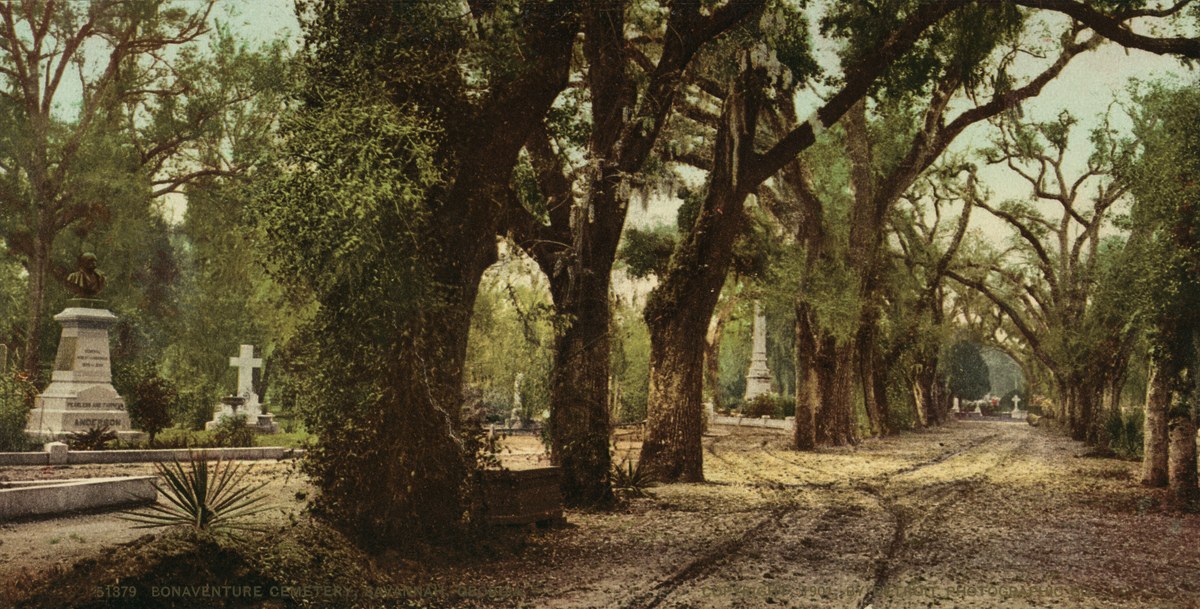
Bonaventure Cemetery sits on a bluff above the Wilmington River, east of downtown Savannah, Georgia. It is a working municipal cemetery, a Victorian-era garden landscape and one of the most photographed burial grounds in the country. Much of that fame comes from sculpture, a 1994 bestselling novel and stories about a few of the people buried here. This post separates what the records support from what is folklore, and it covers how to visit.
What the record shows
The cemetery occupies the former Bonaventure Plantation, once owned by Colonel John Mullryne. On March 10, 1846, Commodore Josiah Tattnall III sold the property to Peter Wiltberger, according to Wikipedia. Wiltberger planned a cemetery of about 70 acres, as the Telfair Museums describe it, and the first burials followed in 1850. After his death in 1853, his son William formed the Evergreen Cemetery Company in 1868. The Bonaventure Historical Society (BHS) says Evergreen was a private business laid out as a Victorian cemetery with curving paths, many trees and lawns, where families also met to picnic.
The City of Savannah bought the Evergreen company on July 7, 1907, according to Wikipedia, making the cemetery public and renaming it Bonaventure. The neighboring Greenwich estate later became the Greenwich Addition. Wikipedia dates that to 1933, while the Telfair says the city bought the estate in 1937. The cemetery was listed on the National Register of Historic Places on February 2, 2001.
The size is also reported two ways. The city says the cemetery has over 100 acres, and BHS says nearly 103 acres. Some references still repeat an older figure of 160 acres.
Notable burials include songwriter Johnny Mercer, whose family plot BHS places at H-48, and the poet Conrad Aiken. According to the New Georgia Encyclopedia, Aiken had a marble bench placed beside his parents’ graves with two inscriptions, “Give my love to the world” and “Cosmos Mariner Destination Unknown.” Photographer Jack Leigh and the sculptor John Walz, who carved more than 70 works in the cemetery according to the Telfair, are also buried here. The city says more than 500 Confederate dead lie in the cemetery.
The naturalist John Muir passed through Savannah in October 1867 on his walk to the Gulf of Mexico. In his book he describes camping in the cemetery for about five or six days while waiting for money from home, and he wrote admiringly of the live oaks and Spanish moss. Wikipedia gives the length of his stay as six days.
The legends
Gracie Watson. The best-known monument is the life-size marble figure of Gracie Watson, a six-year-old who died in 1889. BHS says she was the daughter of a hotel manager and a favorite of the guests, and that her monument was carved by John Walz from a photograph. Her grave, E-98, is behind an iron fence. Visitors leave toys and gifts, especially around Christmas. BHS says her nose was damaged before the fence went up and gives three possible explanations: a thrown stone, frequent rubbing or weathering. The nose was rebuilt. Some retellings add ghost stories about the statue or the former hotel, but no source reviewed documents any of them.
Corinne Elliott Lawton. Corinne was the eldest daughter of Confederate General Alexander R. Lawton and died on January 24, 1877. Her monument, by the Sicilian sculptor Benedetto Civiletti, is a kneeling figure at the foot of a cross. Dramatic tales of her death circulate among visitors. Savannah.com, citing her mother’s diary, says she died in bed after five or six days of illness, surrounded by family, and calls the stories fiction. It names the illness as most likely pneumonia. A funeral notice republished by a local genealogy blogger gives no cause, so the exact illness is unconfirmed. No source reviewed supports the dramatic versions.
The Bird Girl. The bronze figure on the cover of John Berendt’s 1994 book, Midnight in the Garden of Good and Evil, was designed as a garden statue. Telfair Museums say Sylvia Shaw Judson created it in 1936 and that Lucy Boyd Trosdal bought a cast around 1938 for the family plot. After the book drew crowds, the Trosdal family removed it and later loaned it to the museum for safekeeping. The city dates the removal to 1995 and the move to the Telfair to 1997.
Other stories. Phantom dogs, orbs of light and statues said to change expression appear on tour and travel sites. These are anecdotes, and no records document them.
What the record does not support
- Gracie’s date of death. Wikipedia gives April 22, 1889, and says she fell ill a few days after Easter, citing the National Register form. A cemetery blog says Easter fell on April 21 that year and that she died the next day. BHS says she died two days before Easter. Sources disagree, and this post does not choose between them.
- The date of her statue. Wikipedia says the statue was completed in 1890. The Telfair says John Walz completed it in 1894.
- The suicide story. The Lawton legend has no support in the records reviewed. The claim that Corinne’s statue turns its back on heaven also fails on timing, since her father’s own monument was not added to the plot until after his death in 1896.
- The Bird Girl’s meaning. The Telfair says the figure’s pose does not symbolize weighing good and evil. Its bowls were meant to hold food or water for birds.
- The film’s version of the book. The city says Jim Williams, a central figure in Berendt’s book, is not buried at Bonaventure, as the film implies. He is buried near Gordon, Georgia.
The City of Savannah does not allow tours or events marketed as haunted, paranormal or involving ghosts in its municipal cemeteries, and its cemetery FAQ calls sensationalizing the sites inappropriate. Visitors are asked to focus on history, art and the natural setting.
Visiting
Bonaventure Cemetery is at 330 Bonaventure Road, Savannah, GA 31404. It is free and open every day of the year from 8 a.m. to 5 p.m. The city’s Department of Cemeteries runs the grounds and can be reached at (912) 651-6843.
BHS offers free one-hour guided tours on the second weekend of each month. As of this writing, tours at 1 p.m. on both Saturday and Sunday are listed for November 14 and 15 and December 12 and 13, 2026. A free ticket is required, space is limited and dates can change, so check the BHS tours page first. The tours start at Colonial Garden, inside the cemetery. Private companies run paid walking, golf cart and Segway tours. Commercial tours and groups of 10 or more must register with the city.
BHS lists these rules:
- Stay on the pathways. Plots are private, and a camera zoom works for a closer look.
- Do not put rocks on stones or add or remove anything from a monument.
- Alcohol and firearms are not allowed in city cemeteries.
- Keep pets on a leash and on the paths, and clean up after them.
- Rubbings need written consent from the family that owns the monument.
- Be quiet near any funeral in progress.
There are restrooms by the entry gates but none inside. Parking is free, and BHS suggests the large lot by the river at the end of Mullryne Way. Most paths are dirt and gravel and can be hard for wheelchairs. BHS recommends comfortable shoes, bug spray for sand gnats and bottled water.
To see the Bird Girl, check Telfair Museums first. The city says the statue moved there in 1997, and Wikipedia says it went to a dedicated space at the Jepson Center in 2014. The museum’s Bonaventure exhibition at the Telfair Academy ran through March 22, 2026. Its current gallery was not confirmed for this post.
FAQ
Is Bonaventure Cemetery free to visit?
Yes. The cemetery is free and open every day from 8 a.m. to 5 p.m.
Where is Little Gracie Watson’s grave?
It is at E-98, behind an iron fence. Please keep to the path and do not climb the fence.
Can I see the Bird Girl statue at Bonaventure?
No. It was removed after the 1994 book made the site popular and is on long-term loan to Telfair Museums from the descendants of the family that bought it. Confirm where it is displayed before you go.
Are there haunted tours at Bonaventure?
Not in the cemetery. The city prohibits tours marketed as haunted or paranormal in its municipal cemeteries. History tours are offered by BHS and by private companies.
More haunted cemeteries: Read about St. Louis Cemetery No. 1 in New Orleans, Pilgrims Rest Cemetery in Ormond Beach, Florida, Huguenot Cemetery in St. Augustine and Bladon Springs Cemetery in Alabama.
Sources
- City of Savannah: Bonaventure Cemetery: address, hours, acreage.
- City of Savannah: Cemetery Tourism and Special Events: the ban on haunted-marketed tours and the registration rules.
- City of Savannah: Cemeteries FAQ: haunted question, Bird Girl, Jim Williams, Confederate burials.
- Bonaventure Historical Society: History, Little Gracie Watson, FAQ, Tours and You Should Know.
- Telfair Museums: Monument Makers of Bonaventure Cemetery and Before Midnight: Bonaventure and the Bird Girl Exhibition Guide: Walz, Evergreen history, the Bird Girl and Greenwich.
- Telfair Museums: Before Midnight, Bonaventure and the Bird Girl: exhibition dates.
- Wikipedia: Bonaventure Cemetery and Gracie Watson: dates and notable burials, used only where marked.
- To Die for Images: Little Gracie Watson at Bonaventure Cemetery: the Easter date note.
- New Georgia Encyclopedia: Conrad Aiken and the National Register listing (reference 01000035).
- John Muir: Camping among the Tombs, from A Thousand-Mile Walk to the Gulf.
- Savannah.com: Bonaventure Burial, Corinne Elliott Lawton and Ruthrawls’s Blog: Corinne Elliott Lawton obituary, 1877.
Shop the gear
Heads up: NicheStuff is our own shop, so we earn from purchases made through these links. Prices and availability are set on the store and can change.
Top image: Gateway entrance to Bonaventure Cemetery in Savannah, Georgia. Photo: Myotus, CC BY 4.0, via Wikimedia Commons.
2 comments