
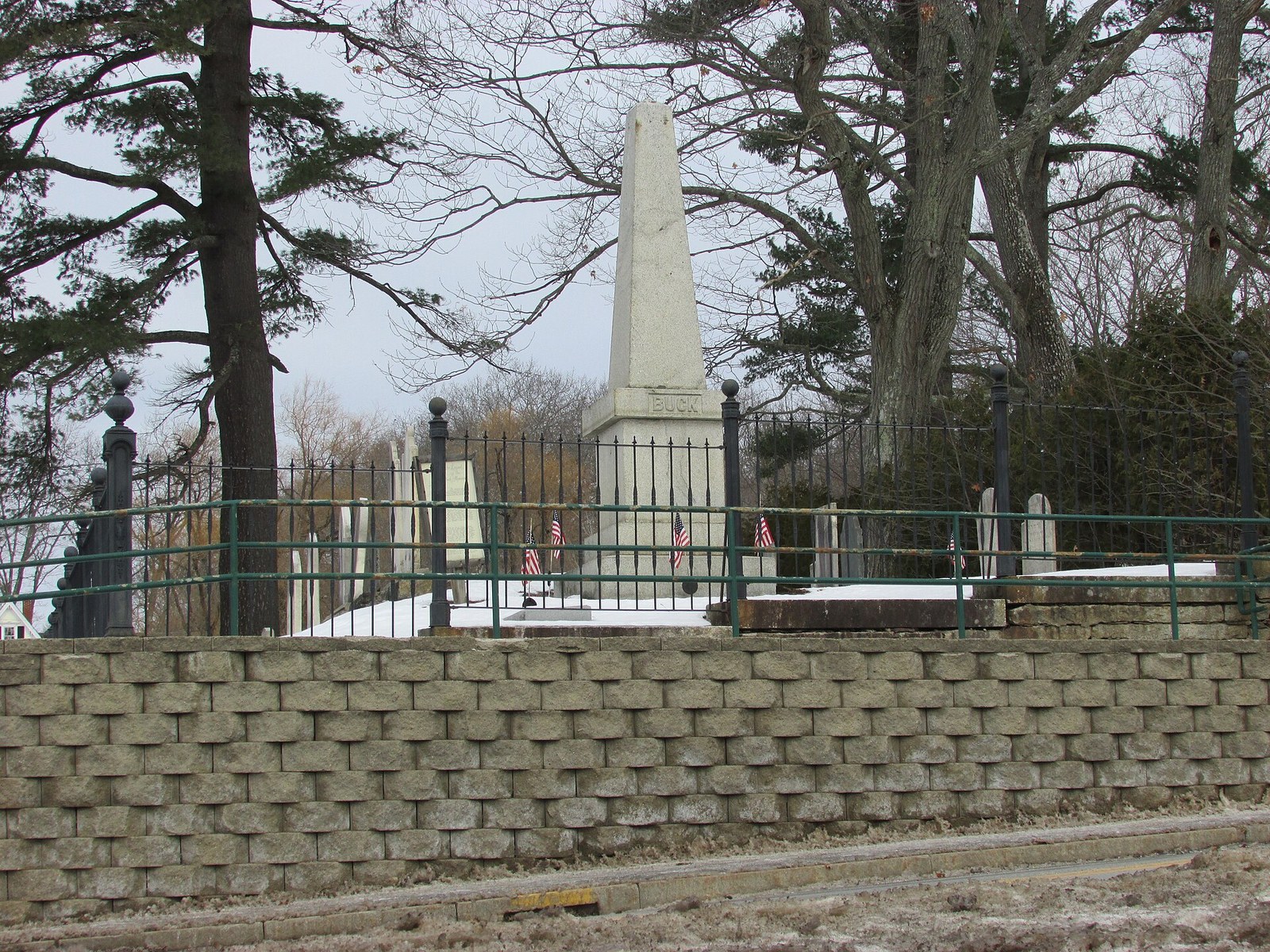
Buck Cemetery stands on U.S. Route 1 in Bucksport, Maine, and its best-known feature is a granite obelisk over the grave of Colonel Jonathan Buck, the founder of the town. A dark mark below his name is said to be the outline of a woman’s leg and foot, left by the curse of a woman he supposedly sentenced to death as a witch. This post separates the documented history from the legend, which every source read for it traces to after the mark appeared, and explains how to see the monument respectfully.
What the record shows
A history of the Buck legends written for Bucksport’s bicentennial and posted by the town says Jonathan Buck was born in Woburn, Massachusetts, on February 20, 1719, and grew up in Haverhill. In 1762 he sailed up the Penobscot River to survey plantations that later became Bucksport and several neighboring towns, and in 1764 he began building the first settlement on what was then Plantation No. 1. That plantation was renamed Buckstown in his honor in 1792. The same history says he died on March 18, 1795, and was buried in a cemetery east of the settlement. His grandchildren erected a monument near the grave in August 1852.
The roadside historical marker beside the monument calls Buck an honorable, industrious man who founded the community and built its first sawmill, its first grist mills and its first boat. As transcribed on the Historical Marker Database, the marker says the monument is made of Blue Hill granite and was erected by his descendants nearly sixty years after his death.
Sources do not agree on every detail:
- Date of death. The town history and the Bangor Daily News give March 18, 1795. The marker, as transcribed on the Historical Marker Database, gives March 13, 1798.
- Who erected the monument. The town history and the Bangor Daily News say grandchildren, and the marker says descendants, and the Daily News says the plaque states this is the original monument. Atlas Obscura says the stain appeared 75 years after Buck’s death, which would be about 1870 and does not match either the 1852 monument date or the marker’s “nearly sixty years.” The town history, the Bangor Daily News and the marker agree on a monument from the 1850s, so that date is the better supported one.
The legend
The witch story is attached to the stain on the monument. In the best-known version, Buck, a strict Puritan, sentenced a woman to death for witchcraft. As she was about to be executed, she told him a stone would one day mark his grave and that her imprint would appear on it for all time, so that people would know he had murdered a woman.
The town history says this version first appeared in print in the Haverhill Gazette on March 22, 1899, which in turn credited an undated edition of a Philadelphia newspaper. A version in a New England magazine in 1902 followed. The roadside marker tells a different version: the woman was burned, her leg fell from the fire, and her deformed son grabbed it, insulted the Colonel and fled into the wilderness. In other versions she is pregnant with Buck’s child, or has a son by him. A 1930s account has a man accused of killing a woman and removing her leg, who says the leg’s appearance on Buck’s tombstone will be his vengeance. A long poem about the story was published in 1939.
What the record does not support
Every source read for this post treats the witch story as fiction, and gives these reasons:
- No record has been found of anyone executed for witchcraft in Maine, and the town history adds that no one is known to have been burned there.
- The New England witch trials ended before Buck was born, and as a justice of the peace he had no authority to sentence anyone to death.
- No version of the legend has been found that dates from before the mark appeared. The marker itself says the curse was unheard of before the flaw showed up. The Bangor Daily News quotes a local author’s account saying the 1899 story was written by a bored newspaper reporter looking for news, and that it then spread across the country.
- The town history says Buck’s descendants were dismayed by the story and reportedly threatened to sue for slander.
The mark itself is explained as a natural flaw in the granite, perhaps a vein of iron that darkens through contact with air. The town history says attempts to remove it have failed and that it comes back, and the marker says stonecutters call such a stain common in granite that appears after cutting and polishing. The marker also notes a heart-shaped outline on the upper part of the monument and says rumors that the monument was replaced are untrue.
Visiting
Buck Cemetery is at 68 U.S. Route 1 (Main Street) in Bucksport, where the roadside marker stands at U.S. 1 and Hinks Street. Atlas Obscura describes the monument as sitting at the southwest corner of the cemetery near that intersection, and says visitors cannot go inside the fence but can see and photograph it easily from outside. It also reports free parking on Hinks Street. No official hours, rules or contact details were found for this post, so those points are not confirmed.
A few points of courtesy apply:
- View and photograph the monument from outside the fence.
- Do not touch, scrub or try to remove the mark. The cemetery holds real graves.
- Keep to daylight hours and keep voices low. The cemetery is beside U.S. 1 near the middle of town.
- Leave nothing behind.
FAQ
Is Buck Cemetery in Bucksport haunted?
No haunting is documented. The “witch’s curse” is a legend tied to a mark on a monument, and the sources read for this post say the story appeared only after the mark did.
Was a witch really executed by Colonel Buck?
No record of it has been found. There is no record of anyone executed for witchcraft in Maine, and a justice of the peace could not order an execution.
What is the mark on the Buck monument?
It is a dark outline under Buck’s name that is often described as a leg and foot. The town history and the roadside marker attribute it to a natural flaw in the granite.
Can visitors go inside Buck Cemetery?
Atlas Obscura says no, and that the monument can be viewed from outside the fence. Confirm any current rules with the Town of Bucksport.
More haunted cemeteries: Another Northeast entry is Union Cemetery in Easton, Connecticut. Other Northeast entries include Our Lady of the Rosary Chapel and Stepney Cemetery in Monroe, Connecticut and Oak Hill Cemetery in Georgetown, Washington, DC.
Sources
- Town of Bucksport: “Legends of Jonathan Buck” (bicentennial history, PDF): life dates, the 1852 monument, the first printed legend, the versions and the evidence against them.
- Historical Marker Database: The Legend of the Buck Memorial: transcription of the roadside marker, location and the 1798 date.
- Bangor Daily News: “Have you heard the legend of Jonathan Buck?” (October 28, 2015): 1795 date, 1852 monument, marker text, how the story spread.
- Atlas Obscura: Cursed Memorial of Colonel Buck: legend variants and visitor notes (a visitor guide, not an official source).
Shop the gear
NicheStuff is our own shop; some links in this post go to products we sell.
Top image: Buck monument at Buck Cemetery, Bucksport, Maine, December 2016. Photo: DrStew82, CC BY-SA 4.0, resized, via Wikimedia Commons.